Romance of the Three Kingdoms
A 14th-century novel blending history and fiction from China's Three Kingdoms.

It is one of the Four Great Classic Novels of Chinese literature, blending history with fiction and centering on the rival states of Cao Wei, Shu Han, and Eastern Wu.
- Author
- Luo Guanzhong (attributed)
- Language
- Chinese
- Genre
- Historical novel
Lore & Background
The novel is based primarily on the Records of the Three Kingdoms by Chen Shou, written in the 3rd century. It romanticizes the lives of warlords and their retainers, with a pro-Shu perspective, depicting political maneuvering, military campaigns, and personal rivalries over nearly a century. Luo Guanzhong, a playwright of the late Yuan to early Ming period, is traditionally credited with compiling the novel. The author used historical records, Tang dynasty poetry, Yuan operas, and his own interpretations of virtue and legitimacy. The Mao version, with commentary nearly two-thirds as large as the text, includes an introductory essay on legitimacy. The novel has nearly a thousand dramatic characters and is widely read in East and Southeast Asia.
Reader's Guide
Romance of the Three Kingdoms is acclaimed as one of the Four Great Classic Novels of Chinese literature and is arguably the most widely read historical novel in late imperial and modern China. Its literary influence in East Asia has been compared to that of Shakespeare on English literature. The novel's impact extends to Southeast Asia, where many characters have become household names. Herbert Giles stated that for the Chinese themselves, it is regarded as the 'greatest among their countless novels.'
The work blends history with fiction, shaping popular understanding of the Three Kingdoms period. Its pro-Shu perspective and dramatic portrayals of figures like Liu Bei, Guan Yu, and Cao Cao have influenced countless adaptations in opera, film, and games. The Mao recension, with its commentary and editing, became the standard text, while earlier illustrated editions like Zhou Yue's contributed to its popularity. The novel's exploration of loyalty, strategy, and legitimacy continues to resonate, making it a cornerstone of Chinese cultural heritage.
Did You Know?
- The standard text is a recension by Mao Lun and Mao Zonggang from the 1660s.
- Herbert Giles called it the 'greatest among their countless novels' for the Chinese.
Authorship and the Question of Origin
Romance of the Three Kingdoms has never had a single confirmed author. While tradition credits Luo Guanzhong, scholars acknowledge considerable uncertainty surrounding the text's creation. The novel circulated in many variants and forms long before it was settled into its classic shape during the late Ming period. Some researchers have suggested that portions might have been composed by Shi Hui or Guo Xun, and there is even speculation that Luo Guanzhong—perhaps a student of the traditionally named author of Water Margin, Shi Nai'an—could have been involved in writing parts of the text. What makes this ambiguity less troubling in the Chinese context is that the novel, unlike poetry or painting, carried little prestige in the literary hierarchy. Authorship simply was not a priority for readers or critics of the era. The work passed through multiple recensions, and no single manuscript was treated as definitive until editors in later centuries stepped in to impose order on the sprawling manuscript tradition.
The Mao Editions and the Birth of a Standard Text
The version of Romance of the Three Kingdoms that most readers and translators encounter today owes much to the editorial work of Mao Lun and his son Mao Zonggang in the late Ming and early Qing periods. These scholars produced an edition that included an introduction, a body of commentary, and a series of cuts, additions, and structural alterations to the text. Crucially, they presented these changes as a restoration of the original author's intent, a claim that modern scholars have found difficult to sustain. Their commentary wove together literary analysis and political interpretation, points that contemporary critics sometimes regard as strained. Despite these complications, the Mao editions achieved a kind of canonical authority: they became the standard text for centuries, and the vast majority of modern translations draw on their version rather than on earlier, more fluid recensions. In this way, the definitive Three Kingdoms that readers know is in significant part a product of seventeenth- and eighteenth-century editorial intervention.
A Story Known by Everyone
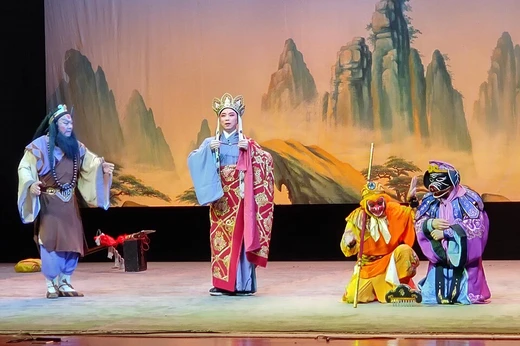
What distinguishes Romance of the Three Kingdoms from most Western literary classics is the depth of its penetration into everyday life across all social strata. During the Ming and Qing dynasties, the novel's plots, characters, key battles, and memorable lines were so widely known that even those who could not read a single character were intimately familiar with the story. They absorbed it through tea-house storytellers who dramatized the campaigns of Cao Cao, Liu Bei, and Sun Quan, through Chinese opera performances, through card games built around the characters, and through the colorful new-year pictures that decorated household doors. This level of cultural saturation far exceeded anything comparable in the European tradition. In the modern era, that same narrative has migrated into graphic novels, animated cartoons, feature films, television series, video games, and even theme parks, ensuring that the Three Kingdoms story remains a living, evolving cultural force rather than a museum artifact.
From Four Masterworks to Four Great Classics
Romance of the Three Kingdoms occupies a shifting position within the Chinese literary canon, reflecting changing attitudes toward what counts as high literature. In the early Qing period, publishers grouped it alongside Water Margin, Journey to the West, and The Plum in the Golden Vase as the Four Masterworks (Sìdàqíshú), a label that emphasized their status as remarkable popular entertainments. The inclusion of The Plum in the Golden Vase, which was banned for much of its existence due to its explicit sexual content, shows how fluid these groupings were. After the Communist takeover, the state publisher People's Literature Publishing House successively reissued collated editions of Water Margin, Romance of the Three Kingdoms, Dream of the Red Chamber, and Journey to the West between 1952 and 1954, effectively dropping The Plum from the set. Since the early 1980s, mainland China has used the term Four Great Classic Novels (Sìdàmíngzhù) for this revised quartet, a designation that carries greater prestige and signals the novel's elevation to the highest tier of Chinese literary achievement.
Frequently Asked Questions
Why is Romance of the Three Kingdoms so important in Chinese literature?
It ranks as one of the Four Great Classic Novels and is widely regarded as the foundational text of Chinese historical fiction. Its themes of strategy, loyalty, and political intrigue have deeply shaped Chinese theater, philosophy, and popular culture for centuries.
More in Literary Novels And Classics 1-15
Spotted an error? Know more?
This is a living reference — every entry is fact-audited, and reader corrections feed straight into our audit queue. Suggest an edit · See this site's audit record